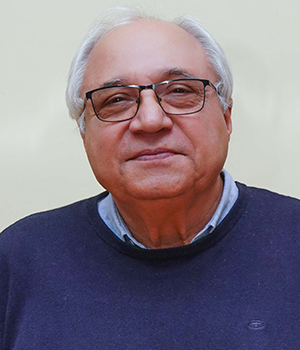
Prof. George Altankov received his MD in 1974 from the Varna Medical Institute, Bulgaria, where he also completed his PhD in 1984. Between 1991 and 1993, he pursued postdoctoral studies at the Southwestern Medical School in Dallas, focusing on the molecular mechanisms of cell adhesion.
From 1985 to 2005, he worked at the Bulgarian Academy of Sciences, advancing to Full Professor, Head of the Department Cell Adhesion, and Deputy Director of the Institute of Biophysics in Sofia. His pioneering studies, conducted in close collaboration with the GKSS Research Centre (Germany), were among the first to demonstrate that tissue compatibility of biomaterials strongly depends on the ability of cells to reorganize surface-associated extracellular matrix proteins such as fibronectin, vitronectin, fibrinogen, and collagen.
From 2007 to 2019, Prof. Altankov held the distinguished position of ICREA Research Professor at the Institute for Bioengineering of Catalonia (IBEC), Barcelona, Spain, leading the group “Molecular Dynamics at the Cell–Biomaterials Interface” consequently leading 3 EU funded research projects in the field of tissue engineering and regenerative medicine.
Upon returning to Bulgaria in 2019, he continued his scientific activity, initially as a consultant and later as a work package leader in the development of the Leonardo da Vinci Center of Competence in Personalized Medicine, 3D and Telemedicine, Robotic and Minimally Invasive Surgery at Pleven Medical University. He currently holds a leading role in project BG16RFPR002-1.014-0002-С001 within the same Center of Competence. His research is further supported by the European Union’s NextGenerationEU program through the National Recovery and Resilience Plan of the Republic of Bulgaria (project BG-RRP-2.004-0003).
Prof. Altankov is the author of more than 150 original research papers in international journals and over four book chapters, with his work cited more than 3,500 times (Google Scholar, h-index = 36). He is also the holder of five patents.